
Fleet managers choosing between leaf springs and independent trailer suspension are making a business calculation. Suppliers and fleet analysts describe the choice as a function of operating terrain, cargo sensitivity, maintenance logistics and total cost of ownership. Both designs have long service histories in commercial transport, and both remain in volume production.
How the two systems differ
A leaf spring trailer carries both wheels of an axle on a single solid beam, so a force acting on one wheel travels through the axle to the opposite side. Parts suppliers describe the axle as a rigid connection, and that rigidity shapes how the whole system behaves on uneven ground. Slipper springs, a common variant in light-to-medium commercial trailers, are durable and cost-effective.
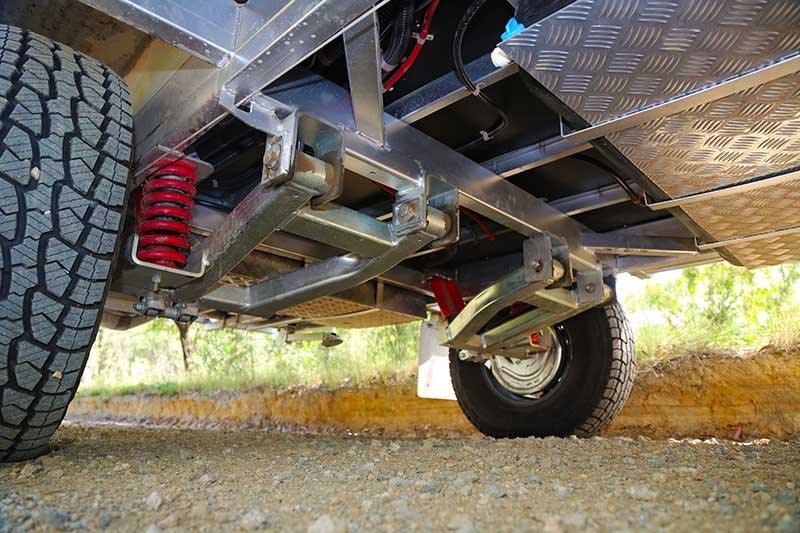
Independent suspension gives each wheel its own trailing arm. In the coil and air designs compared here, coil springs or airbags absorb movement at that wheel alone. Manufacturers of these systems say the design keeps road shock at one corner of the trailer, leaving the opposite wheel unaffected.
The difference also appears in unsprung weight, the mass of suspension arms, axles and wheels carried below the springs. Industry guidance holds that lower unsprung weight helps tires stay in contact with the road, a point independent-system makers cite as a core benefit. Those designs also rely on shock absorbers, velocity-sensitive dampers that control spring rebound and help limit trailer sway.
On uneven ground, when one wheel of a beam axle drops into a pothole or rides over a ridge, the axle twists and the trailer body moves with it. The load inside feels that movement, while independent arms absorb the same event at the wheel.
The upfront cost equation
Trailer builders and parts suppliers consistently price leaf spring running gear below independent systems, and the gap comes from manufacturing complexity. A leaf spring axle group has few components, is produced in high volumes and is made by many competing manufacturers, all of which keeps acquisition prices low.
Coil and air independent assemblies add a trailing arm, a coil spring or airbag, and a damper at every wheel position, so builders price them higher. Procurement guidance for fleet buyers treats that higher figure as a capital decision, one to be weighed against operating costs across the trailer’s working life.
Fleet analysts usually compare the two through total cost of ownership, which balances acquisition price against maintenance, tire wear and downtime. A cheaper axle that wears tires faster, or a dearer one that protects freight, can reshape the calculation for a given operation.
Suppliers also note that leaf spring running gear is stocked widely through aftermarket channels, which matters for fleets rebuilding or upgrading older trailers.
Maintenance across a working life
Purchase price starts the cost calculation, and fleet maintenance manuals describe the service profiles of the two designs as different in kind. Leaf spring assemblies have fewer moving parts, but their needs are frequent. Shackle bolts and bushes are the critical wear items, and workshop guidance calls for regular lubrication and inspection because neglected pins and bushes can progress to failure with little warning.
Suppliers offer bushes in polyurethane and bronze, and they say the material choice changes service intervals and resistance to road grime. Fleet workshops report that either material performs if the greasing schedule is followed, and skipped greasing shortens the life of both.
Independent systems carry more pivot points per axle, and each pivot is a service item with its own bush or bearing. Manufacturers say the design isolates the trailer frame from repeated shock loads, reducing structural fatigue in the chassis and body over high mileage.
Neglect has a measurable cost. Suspension condition and tire wear belong in the maintenance budget. Service intervals are not fixed numbers in fleet manuals; they shift with route severity. Guidance for mixed-network fleets advises shortening greasing and inspection cycles for trailers that spend regular time on unsealed roads. Corrosion protection belongs in the same budget for fleets working near the coast or in chemically harsh areas. Suppliers recommend galvanized or equivalent surface treatments on springs, hangers and hardware in those conditions, whatever the suspension design.
Parts supply and repairs away from base
Maintenance planning also extends to where parts come from, and for fleets working far from their own workshops, repairability can decide the suspension question early. Common leaf spring components are often easier for a regional workshop to source. Confirm the dimensions and load rating for the trailer before ordering.
Independent systems use proprietary arms, bushes and dampers, and operators report that a damaged component in a remote area can mean waiting on shipped parts. Manufacturers point to their dealer and distributor networks, though the distance between outlets still matters on remote routes.
Fleet buyers running leaf spring trailers are advised by suppliers to keep common wear items on the shelf. A search for trailer parts australia, followed by a stock check with the supplier when ordering, helps a fleet source shackle pins, bushes and u-bolts, the hardware suppliers identify as most often needed to cut vehicle-off-road time.
Fleet cost analyses treat vehicle-off-road time as lost revenue, and planners say a trailer waiting on a small part costs the same per day as one waiting on a large one.
Maintenance planners also recommend a small spares kit on trailers working remote contracts, matched to the suspension fitted. The kit list differs by design, but the planning principle, according to fleet maintenance guidance, does not.
Tire wear and alignment
Suspension condition shows up in tires first, and wheel alignment is where the two designs differ most for tire budgets. Independent suspensions allow toe and camber adjustment at each wheel, and manufacturers say a workshop can correct uneven wear before it destroys a set of tires.
A leaf spring beam axle has fixed geometry, so toe and camber are set by the axle itself. Workshop guidance holds that a bent or misaligned beam generally cannot be adjusted back into specification, and that correction typically means replacing the axle beam.
Fleet maintenance benchmarks treat tire condition as an early indicator of suspension trouble. Uneven wear across an axle group points to alignment problems, worn bushes or overloading, and catching the pattern early costs less than the tires.
Independent-system manufacturers add that consistent tire contact spreads work evenly across the tread. Leaf spring suppliers answer that correct spring rating and axle specification deliver even wear in line-haul work, and both sides cite fleet records.
Corrugations, braking and cargo
The case for consistent tire contact is strongest on rough surfaces. Corrugated roads, the high-frequency undulations common on rural Australian highways, subject trailer suspensions to severe fatigue, according to suspension manufacturers and road condition reporting.
Manufacturers of independent systems say their trailing arms let each tire follow the surface and hold contact with it. They argue that a leaf spring trailer can begin to bounce on corrugations, and that a bouncing tire has less grip, which reduces braking efficiency and stability.
Operators of leaf spring fleets note that correct spring ratings, serviceable dampers where fitted, and sound tire pressures keep their trailers stable on the same roads. Both positions appear in industry guidance, and both return to matching equipment to route.
Cargo is the other half of the ride question. Manufacturers of independent systems say their damping absorbs high-frequency vibration that passes readily through stiff leaf springs, and freight handlers report less damage to sensitive loads on better-damped trailers. Freight handlers place electronics and packaged produce in the sensitive category, and they say vibration damage claims cluster there. Procurement guidance advises fleets carrying fragile or high-value freight to treat vibration exposure as a cost line in the business case.
Load sharing on multi-axle trailers
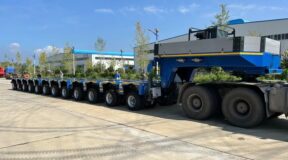
Design adds another constraint once a fleet moves to multi-axle trailers. The suspension has to distribute weight across all wheels in an axle group, and the right configuration depends on the actual trailer. Design documentation from the manufacturer establishes which arrangement suits a given unit, so load sharing is a design question.
Rocker-roller leaf spring arrangements are the long-established mechanical answer, and their pivoting rocker assemblies share load between axles. Independent pneumatic systems approach the same requirement with airbags, and manufacturers say air pressure can equalize load across the group automatically.
Aggregate Trailer Mass (ATM) is the total mass of a trailer at its manufacturer’s maximum recommended load, including the load on the coupling. Check the axle loads, component ratings and applicable requirements when specifying the suspension, because adding capacity later is rarely straightforward.
Compliance advisers recommend keeping documentation of the load-sharing arrangement for each trailer, since it is commonly requested at inspection. They also note that worn suspension components can put a load-sharing group out of tolerance before any visual sign appears.
Standardizing components across the fleet
Whatever the mix of designs, fleet maintenance guidance makes a consistent point about parts strategy: standardization lowers cost. A fleet running one or two suspension configurations holds fewer part numbers, needs less shelf space and can align service intervals across vehicles.
Procurement officers are advised to record the exact springs, bushes, pins and damper part numbers for every trailer at purchase. Aligned intervals also let a workshop grease, inspect and replace bushes across the fleet in planned blocks, which maintenance planners say converts unscheduled repairs into scheduled ones.
Mixed fleets often discover, at the worst moment, that two similar-looking trailers take different hardware.
Standardization does not require a single suspension type. A fleet can standardize within types: leaf springs on remote routes, independent units on metropolitan freight, each group with its own tight parts list. Maintenance planners describe that split as practical for mixed operations.
Fleet analysts frame the decision as a per-route, per-load calculation. The practical next step is an audit of where each trailer works and what it carries, matched against the total cost of ownership figures the fleet already holds. Those answers, according to the guidance, specify the running gear more reliably than any product brochure.